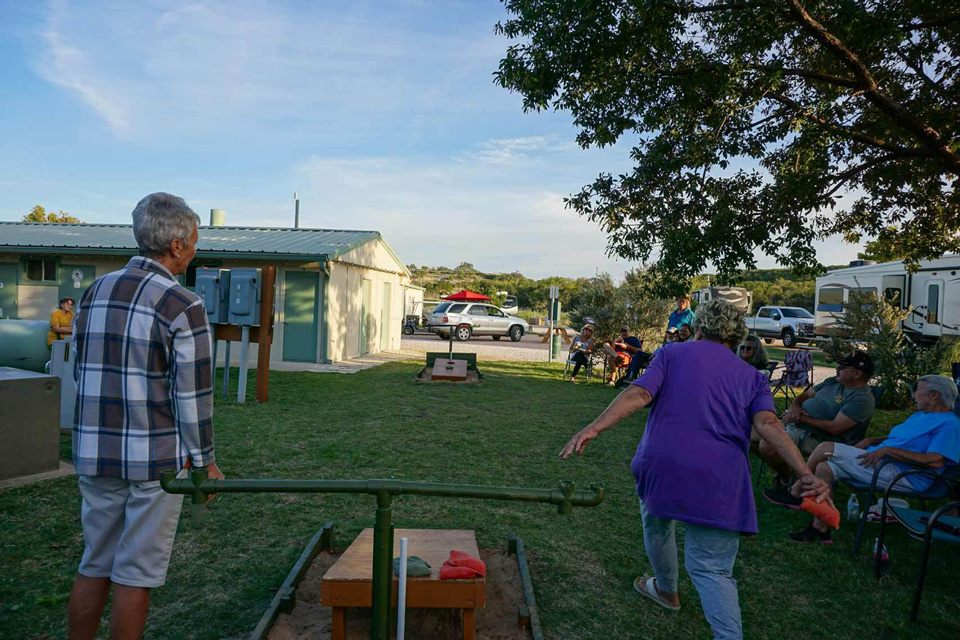

An RV electrical hookup is the shore power connection at your campsite that feeds 120-volt AC power into your rig through a power pedestal. At electric sites, the two most common service ratings are 30 amp and 50 amp, and the difference between them is much larger than the numbers suggest. Availability varies by park, site type, and the age of the electrical system.
Getting the match right decides whether you can run your air conditioner and your microwave at the same time, or whether you spend your first evening resetting a breaker in the dark. This guide covers what is inside a power pedestal, how to identify which service your rig needs, the NEMA plug types you will encounter, what adapters can and cannot do, and the voltage and wiring faults that damage RV appliances. If you are new to RVing, start at the top.
What an RV Electrical Hookup Actually Is

The term “hookup” covers three utilities at a campsite: electric, water, and sewer. This guide covers the electrical connection only.
The Power Pedestal
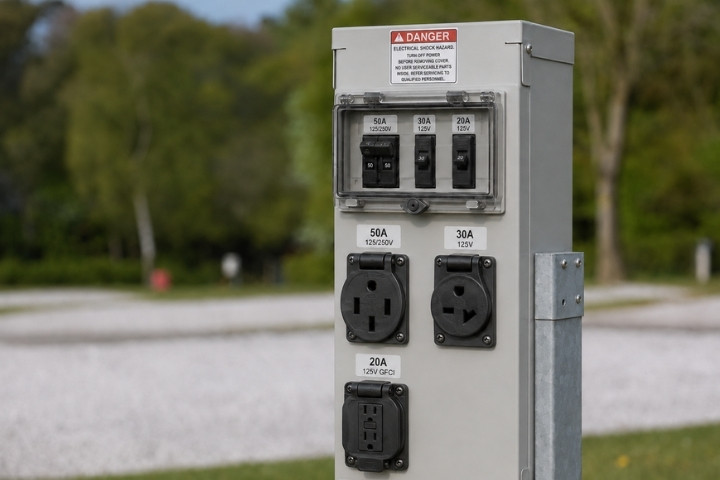
The power pedestal, sometimes called a hookup post, is the weatherproof box at your site housing the receptacles and their breakers. Most campgrounds fit a pedestal with some combination of three:
- A 50-amp receptacle (NEMA 14-50R) on a double-pole 50-amp breaker
- A 30-amp receptacle (NEMA TT-30R) on a single-pole 30-amp breaker
- A 20-amp household-style receptacle (NEMA 5-20R) for small loads
Not every pedestal has all three. Older parks and state campgrounds often provide 30-amp and 20-amp only. Note that the pedestal breakers protect the park’s wiring, not your RV.
The Load Center
Your shore power cord runs from the pedestal to the RV’s inlet, then to the load center, the breaker panel inside your rig. It splits incoming power into branch circuits and feeds the converter, which charges your house batteries and runs the 12-volt DC system. The converter draws power continuously, so your usable budget is always a little smaller than the pedestal rating.
30 Amp vs 50 Amp RV Service

This is the core distinction, and it is the one most often misunderstood.
30 Amp Service (NEMA TT-30)
Thirty-amp service delivers a single 120-volt hot leg, plus a neutral and a ground. The plug has three prongs. The NEMA designation is TT-30, where TT stands for travel trailer: the pedestal receptacle is a TT-30R, the plug on your shore cord is a TT-30P.
Total capacity: 30 amps at 120 volts, or roughly 3,600 watts. Some manufacturers list 3,750 watts, because NEMA rates the device at 125 volts rather than the 120 volts most pedestals deliver. Either figure is a ceiling, not a target.
Thirty-amp service is typical for travel trailers, smaller fifth wheels, older Class C motorhomes, and rigs with a single rooftop air conditioner.
50 Amp Service (NEMA 14-50)
Fifty-amp service delivers two separate 120-volt hot legs, plus a neutral and a ground. The plug has four prongs, and each hot leg can supply up to 50 amps. The pedestal receptacle is a 14-50R, the plug on your shore cord is a 14-50P.
Total capacity: 12,000 watts (two legs, 50 amps each, at 120 volts), or 12,500 watts rated at 125 volts.
The 14-50 is technically a 125/250-volt device, and 240 volts is present between the two hot legs at the pedestal. Almost no RV uses that directly. The load center treats the two legs as independent 120-volt supplies and balances circuits across them, which gives a 50-amp coach far more room for simultaneous highdemand loads. On 30-amp service, an air conditioner and a microwave may exceed available capacity once the converter, refrigerator, and water heater are counted, so that combination often requires careful load management.
Why 50 Amp Is More Than Triple 30 Amp
This is the most common misconception about campground electrical hookups. Fifty amps is not 67 percent more power than 30 amps, and a 50-to-30 adapter does not give you “half” of a 50-amp site.
Run the arithmetic:
- 30 amp: 120 volts x 30 amps = 3,600 watts
- 50 amp: 120 volts x 50 amps x 2 legs = 12,000 watts
That is a 3.3x increase, not 1.67x. The jump comes from the second hot leg, not from the twenty extra amps in the name.
The 20 Amp Household Outlet
The third receptacle on most pedestals is a standard household outlet: NEMA 5-15R (15 amps) or NEMA 5- 20R (20 amps, identifiable by the sideways T-slot on the neutral).
Capacity is 1,800 watts at 15 amps or 2,400 watts at 20 amps, usually enough to keep a refrigerator cold and charge devices, but rarely enough for air conditioning. See the adapter section below.
Service Comparison
| 20 Amp | 30 Amp | 50 Amp | |
|---|---|---|---|
| NEMA type | 5-15R / 5-20R | TT-30R | 14-50R |
| Prongs | 3 | 3 | 4 |
| Hot legs | One | One | Two |
| Voltage | 120V | 120V | 120V per leg (240V across legs) |
| Max watts | 1,800 / 2,400 | ~3,600 | ~12,000 |
| Typical use | Charging, small loads | Single A/C rigs | Two or more A/C units, residential appliances |
How to Tell Which Service Your RV Needs

You do not need the manual for this. Three checks, in order of speed.
Count the Prongs
Look at the end of your shore cord that plugs into the pedestal. Three prongs means 30-amp service, four prongs means 50-amp. A standard household plug means your rig is wired for 20-amp service or you are using an adapter.
Check the Main Breaker
Open the load center and find the main breaker, labeled 30 or 50. That plus the labels on the shore power inlet or cord is usually the fastest way to identify the RV’s intended service. Confirm in the owner’s manual if the labels conflict or the RV has been modified.
Straight Blade and Twist Lock Are Both Normal
If your shore cord detaches at the RV, the two ends will not match, and that is by design. The pedestal end is a straight-blade plug: TT-30P for 30-amp, 14-50P for 50-amp. The RV-side inlet is usually a locking connector with a weather-sealing collar, commonly an L5-30 style on 30-amp cords and SS2-50 on 50-amp cords. Configuration varies by manufacturer, so verify your inlet before buying a replacement cord.
RV Plug Types You Will See at a Campground
| NEMA configuration | Amps | Rated volts | Where you will see it |
|---|---|---|---|
| 5-15 / 5-20 | 15 / 20 | 125 | Household and pedestal convenience receptacle (5-15R / 5-20R) |
| TT-30 | 30 | 125 | 30-amp pedestal receptacle (TT-30R), shore cord plug (TT-30P) |
| 14-50 | 50 | 125/250 | 50-amp pedestal receptacle (14-50R), shore cord plug (14-50P) |
| L5-30 | 30 | 125 | Common locking inlet at the RV end of a detachable 30-amp cord |
| SS2-50 | 50 | 125/250 | Common locking inlet at the RV end of a detachable 50-amp cord |
| 14-30 | 30 | 125/250 | Home dryer receptacle (14-30R). Not an RV outlet |
| 10-50 | 50 | 125/250 | Older range receptacle (10-50R). Three-wire, no separate ground |
The last two are worth calling out. A NEMA 14-30 dryer receptacle is a 30-amp, 125/250-volt outlet with two hot legs, a neutral, and a ground. It is not an RV TT-30 outlet, and a TT-30P will not mate with it. Never bridge the two with a homemade, altered, or unlisted adapter: a miswired one can place 240 volts across a 120-volt RV system. When in doubt, have an electrician verify both the outlet and the adapter.
A NEMA 10-50 range receptacle is a three-wire device with no separate grounding conductor, which leaves the RV chassis without a proper ground path.
Adapters: What a Dogbone Can and Cannot Do
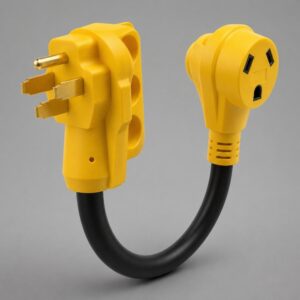
A “dogbone” is a short adapter cable that converts between service types. They are useful, worth carrying, and widely misunderstood.
50 Amp RV on a 30 Amp Pedestal
You plug a 50-amp coach into a 30-amp post using a 30-amp male to 50-amp female adapter. Power reaches the whole coach, but both legs of your load center are now fed from a single 30-amp source. Total available power is 3,600 watts, the same as a 30-amp rig.
In practice: one air conditioner, and load management for everything else. Running two from a 30-amp source will usually exceed capacity and is likely to trip the pedestal breaker.
30 Amp RV on a 50 Amp Pedestal
A 30-amp RV can connect to a 50-amp pedestal using a listed 50-amp-male to 30-amp-female adapter. The rig still has only its 30-amp design capacity, and the extra capacity sits unused.
One caution: the shore cord sits upstream of the RV’s main breaker, so the pedestal breaker protecting it may be rated at 50 amps rather than 30. Use an undamaged, properly rated cord and a listed adapter, and replace the cord if you see cracked insulation, discolored blades, or a loose fit.
Plugging Into a 20 Amp Household Outlet
A listed 15-amp or 20-amp to 30-amp adapter works for keeping the refrigerator running, charging batteries, and running lights while you load up at home. Do not count on air conditioning. Whether a rooftop unit starts on household power depends on the unit, the circuit rating, supply voltage, the length and gauge of the cord run, and what else is drawing. Check the nameplate and the circuit rating first.
What Adapters Never Do
An adapter changes the shape of the connection. It does not change the amount of power available. The lower rating always wins: if either the pedestal or the RV is limited to 30 amps, you have 30 amps. That applies to the adapter and the cord too, since capacity is set by the lowest-rated component in the chain. Use listed equipment rated for the service.
A short list of essential gear for travel trailer owners should include a dogbone adapter in each direction, plus the surge protection covered below.
How Much Power You Actually Have
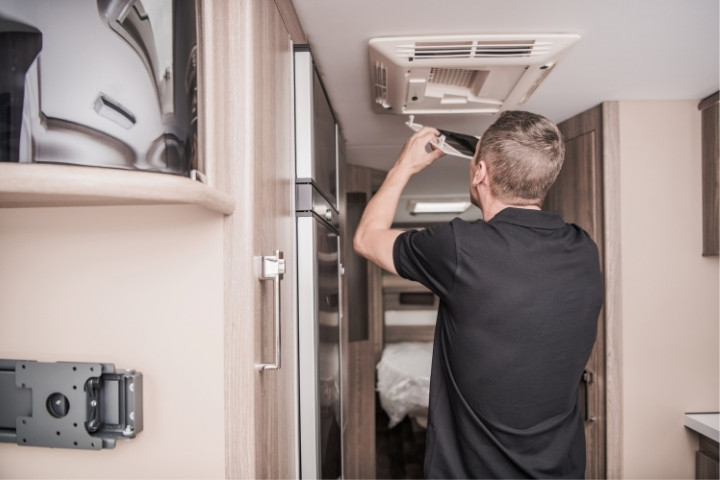
Amperage is a budget. Every appliance spends from it, capped by whichever is lower, your rig’s main breaker or the pedestal’s.
Typical Appliance Amp Draw
Residential refrigerator 3 to 6 Higher during compressor start
Converter / battery charger 3 to 8 Runs continuously
Lights, fans, device chargers 1 to 3
Load Management on 30 Amp Service
The arithmetic is unforgiving. With an air conditioner drawing 13 amps, the converter 4, and the refrigerator 4, you have used 21 of your 30. Adding a microwave at 10 puts you at 31, and the main breaker is likely to open.
Practical habits that keep a 30-amp rig stable:
- Run the water heater on propane, not electric, whenever the A/C is running
- Treat the microwave, hair dryer, coffee maker, and space heater as a group where only one runs at a time
- Give the air conditioner a clear window when it cycles on
Startup Surge and Why Breakers Trip
An air conditioner compressor draws far more current in the first fraction of a second than while running. That inrush, called locked rotor amperage, varies by unit and is why a breaker can hold all afternoon then trip the moment the compressor restarts.
A soft start module, installed at the rooftop unit, can reduce that inrush. It does not lower running amps, so it does not solve an overloaded circuit, but it reduces the spike that trips breakers on marginal service.
Voltage: The Number That Matters More Than Amps
Amperage decides what you can run. Voltage decides what survives. Voltage problems are a significant campground power risk, particularly for motors, compressors, converters, and electronics.
Voltage Thresholds Worth Knowing
Nominal campground power is 120 volts, but the allowable operating range depends on the appliance and its manufacturer specifications. Many RV electrical management systems use protective shutdown points around 104 volts low and 132 volts high. Treat those as common product thresholds and useful warning signs, not a guarantee that every appliance is safe in between. Check your appliance data plates for their specified limits.
What Low Voltage Does
Low-voltage conditions, sometimes called a brownout or a sag, can occur at heavily loaded campgrounds during peak cooling demand.
Motors take the worst of it. To deliver the same wattage at lower voltage, a compressor draws more current, and that extra current turns into heat inside the windings. Sustained low voltage can overheat and damage compressor motors in rooftop air conditioners and some refrigerators, so follow the manufacturer’s minimum-voltage specification. Other equipment may also run poorly, shut down, or be damaged, so do not treat a persistent low reading as safe just because some devices still appear to work.
What High Voltage Does
At the high end, the risk shifts to electronics. Control boards in the converter, the refrigerator, and the microwave are vulnerable, and damage can be immediate rather than cumulative. This is why many EMS units disconnect somewhere around 132 volts.
Checking Voltage Yourself
A plug-in voltage monitor in an interior outlet gives a live reading for a few dollars. Watch it when the air conditioner cycles on. If voltage sags sharply and does not recover, the problem is upstream of your rig and should be reported to park staff.
Pedestal Wiring Faults and How to Catch Them

Campground pedestals live outdoors, take abuse from thousands of connections, and are not always wired correctly. Three faults are worth knowing by name.
Reverse Polarity
Hot and neutral are swapped. Appliances still run, which is what makes this dangerous. Switches and fuses end up on the neutral side, so devices remain energized even when switched off.
Open Ground and Hot Skin
The ground conductor is missing or broken. Nothing appears wrong until a fault occurs, at which point the RV chassis can become energized. That is a hot skin condition, felt as a shock or tingle when touching the entry door or steps, especially on damp ground.
An EMS or a purpose-built pedestal tester can identify several wiring faults before you connect. A noncontact voltage tester may give an extra warning, but it is not a complete safety test and should not be relied on to clear a suspected hot skin condition. If anyone feels a shock, keep people away from the RV, disconnect power at the pedestal if you can do so safely, and contact campground management or a qualified technician.
Open Neutral
This is the destructive one, and it applies specifically to 50-amp service. With a broken neutral, the two 120volt legs are no longer referenced properly and voltage redistributes according to the load on each side. A lightly loaded leg can climb well above 120 volts, and in a bad case appliances see close to 240 volts and fail at once.
Delayed reconnect for compressor protection No Yes, usually 2 to 3 minutes
A basic surge protector may help with transient spikes, but many models pass a sustained low voltage straight through to your air conditioner. An EMS monitors continuously, can cut power before damage occurs, and waits out a reconnect delay so the compressor is not asked to restart against system pressure. Coverage and cutoff thresholds are product-specific, so verify them in the manual for the unit you buy.
Both come in portable and hardwired versions. Match the unit to your service, 30 amp or 50 amp, and choose an outdoor-rated model for portable use.
How to Connect to a Campground Electrical Hookup Safely

The order matters. It protects both your rig and the pedestal contacts.
Connecting:
- Inspect the receptacle for cracks, burn marks, corrosion, or a loose fit, and report damage to park staff before using it.
- Switch the pedestal breaker to OFF.
- Plug in your surge protector or EMS and let it finish its diagnostic cycle.
- Connect the shore cord, seating it fully. A loose connection creates resistance, and resistance creates heat.
- Switch the pedestal breaker to ON.
- Check voltage and fault indicators before turning on major appliances.
- Unroll the cord completely. A coiled cord under load builds heat.
Disconnecting: turn off major appliances, switch the pedestal breaker to OFF, disconnect the cord and then the surge protector, and close the pedestal cover.
Making or breaking the connection with the breaker off is the point of the sequence. Plugging in under load arcs across the contacts, and repeated arcing pits the blades until the connection runs hot.
Planning Your Power for Texas Hill Country Weather

Regional climate changes what a given amperage is worth, and the Hill Country is a clear example.
Summer
Johnson City sits in the Hill Country, where average July and August highs run in the low to mid 90s. In hot weather an air conditioner runs longer and works harder to hold the thermostat setting, leaving less capacity for everything else on a 30-amp hookup.
A setup that feels comfortable in spring can need closer load management in August. If your coach has two air conditioners, that is when 50-amp service stops being a convenience. Late afternoon is also when parkwide demand peaks and voltage sags are most likely, which is where an EMS earns its keep.
Winter
Hill Country winters are mild, but January overnight lows commonly fall to around 40 degrees. The reflex is an electric space heater, and a 1,500-watt heater draws roughly 12.5 amps, close to what the air conditioner it replaced was drawing. On 30-amp service, a space heater plus an electric water heater plus a coffee maker on a cold morning will likely exceed your capacity.
Propane furnace heat sidesteps this and costs only the blower fan, around 5 to 7 amps on the 12-volt side.
Reliable Hookups in the Heart of the Hill Country

Miller Creek RV Park in Johnson City provides both 30-amp and 50-amp electrical hookups, along with water and sewer connections, so you can book the service your rig is wired for instead of adapting your way through the week.
The location puts you within reach of Fredericksburg, Austin, Blanco, and Dripping Springs, which makes it a practical base for exploring the Texas Hill Country without repacking every morning. If you are still comparing options, our roundup of top-rated RV parks near Fredericksburg is a good starting point, and our checklist for RV camping in Texas covers what to pack.
Reserve your site at Miller Creek RV Park and pick the hookup that fits your rig.