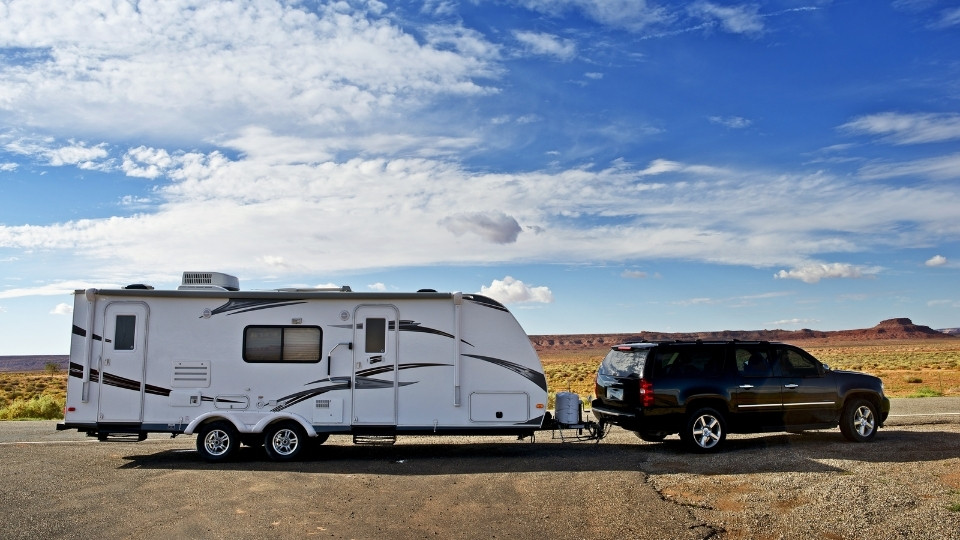
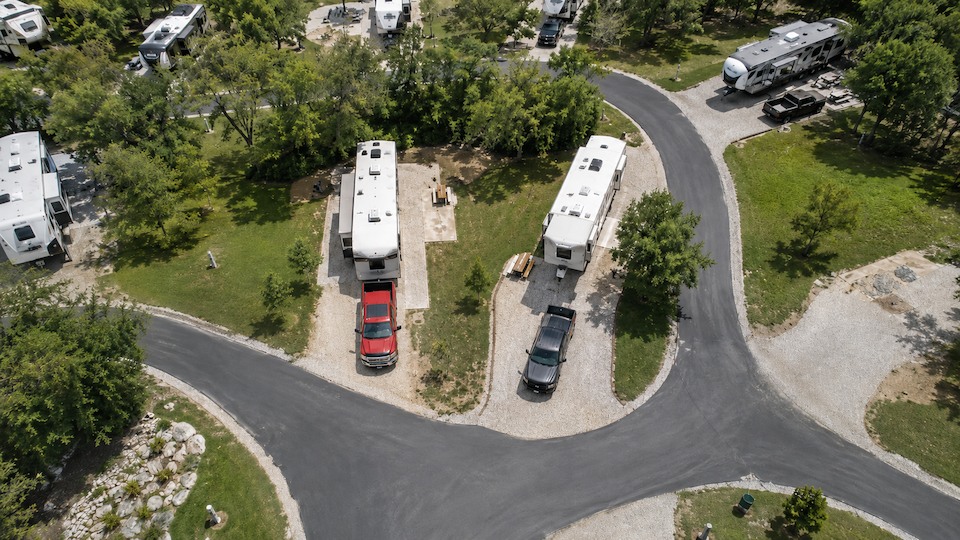
You’re on the booking screen or on the phone with the office, and the site type dropdown is asking you to choose right now. Most first-time RVers reach for pull-through out of habit, assuming it’s easier, costs more, and is simply the safest beginner pick. That assumption doesn’t hold at every park, and it doesn’t hold at Miller Creek RV Park, where the two standard site types are priced identically. The pull-through vs. back-in RV site decision comes down to how long you’re staying and what the site needs to do for you, not how good a driver you are. The short version: pull-through for one or two nights and for the longest rigs, back-in for anything longer, for better rates, and for the sites most parks hold back as their best.
Get the variables in order: length of stay first, rig length second, and the choice that looked obvious on the booking screen often isn’t the one you want.
What Each Site Type Actually Asks of You
A pull-through site lets you drive in one end and out the other, so the whole stay is forward driving only. A back-in site asks for one reversing maneuver on arrival; departure is a straight pull forward, out the same way you’d pull out of a driveway. That second half is the part most articles on this topic skip. Reversing is a one-time event per stay, not a daily one.
Back-ins make up the majority of sites at most parks, since a drive-through lane consumes more land per site than a back-in row does. Pull-throughs are usually the smaller share, positioned for convenience.
Pull-Through vs. Back-In RV Site at a Glance
The two site types compare as follows on the factors that actually change a stay; the note below the table is worth reading before you book.
| Factor | Pull Through | Back In |
|---|---|---|
| Maneuver on arrival | Drive in one end, out the other. No reversing. | Reverse into the site. Straight pull forward on departure. |
| Typical setup time | Shortest. Position and stop. | Longer and highly dependent on the approach angle. |
| Skill required | Minimal. Forward driving only. | Learnable; eases quickly with practice. |
| Tow vehicle | May fit hitched if site length allows. Run the math. | Unhitched and parked alongside or as the park directs. |
| Typical cost pattern | Often priced higher, but not everywhere. | Often the lower rate, especially monthly. |
| Privacy | More open on both ends by design. | Usually, more screening behind the rig. |
| Control over orientation | Fixed by the drive lane direction. | Choose which way the door and awning face. |
| Availability at a park | Usually, the smaller share of sites. | Usually, the majority of sites. |
| Premium and scenic sites | Less commonly, the distinctive sites. | Frequently, where the best sites are. |
| Best suited to | Overnight stops, very long rigs, first arrivals. | Longer stays, orientation control, lower rates. |
This table reflects common industry patterns, not a rule every park follows, and Miller Creek’s own published site specs are the clearest proof: the pattern doesn’t hold at every park, including this one.
How Long You’re Staying Changes the Answer

Length of stay is the first variable to resolve, ahead of rig size or backing skill, because it changes which factor in the table above matters most.
One night. Setup time is nearly the whole decision. Rolling in after dark or leaving before sunrise, a pull-through’s drive-in, drive-out simplicity saves real effort.
About a week. The setup-time difference mostly washes out; you’re only backing in once regardless of stay length, so privacy, orientation, and rate start to matter more.
A month or longer. A single backing maneuver gets traded against thirty-plus days of orientation control, privacy, and rate. The same RVer who wants a pull-through for one night reasonably wants a back-in for a month, and both are correct on their own trip.
What It Actually Costs, and Why the Gap Isn’t Universal
The pull-through vs back-in RV site cost question depends entirely on which rate you’re comparing. Pull-throughs often carry a premium over a comparable back-in at parks around the country, but the spread is wide, and plenty of parks don’t apply one at all. It’s wide enough that it isn’t worth assuming either way before you check. Two things typically drive where it exists: demand for the easier maneuver, and the larger land footprint a drive-through lane takes up.
That pattern isn’t universal. We price our Standard Pull-Through and Standard Back-In identically, $52 a night and $44.57 a night weekly on a seven-night minimum. Same footprint, same price. Rates are starting rates and change over time, so confirm current pricing before you book.
Rates verified against MCRV’s RV Sites page on August 13, 2026.
Where the Gap Shows Up on Monthly Stays
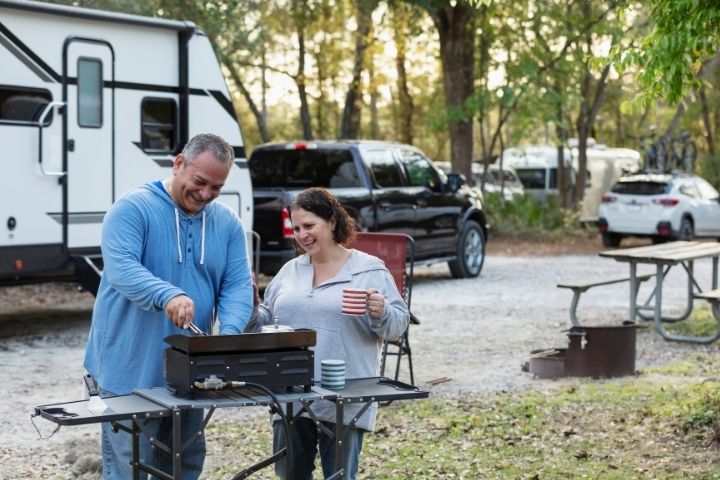
Our Standard Back-In starts at $450 a month, the lowest monthly rate we publish, and our Standard Pull-Through starts at $575. That’s $125 a month to avoid one reversing maneuver on arrival day. On a long-term stay, the site type that costs the same as a back-in overnight becomes the more expensive option by a wide margin.
That’s how the numbers land at our park. Two hundred miles up the road, they may land the other way around, so compare the site types at the length of stay you are actually booking.
Nightly and monthly pricing can answer the site-type question differently, so a rate comparison is only valid at the stay length you’re booking. Confirm current monthly rates directly, since they’re the figures most likely to shift.
Does Your Rig Fit, and Where Does the Tow Vehicle Go?

Here’s the question almost no article on this topic raises: does your tow vehicle fit in the site while it’s still hitched?
The arithmetic is simple. Take the site’s published length and subtract your rig’s length; what’s left is what you have for the tow vehicle, assuming the park allows it to stay hitched at all. A tow vehicle typically adds roughly 18 to 22 feet to your combined length. As an illustrative example, a 35-foot travel trailer behind a 20-foot truck comes to roughly 55 feet combined, well past Miller Creek’s published 45-foot length. Fifth wheels work differently: because the kingpin sits inside the truck bed, roughly six feet of the two overlap, so that same 35-foot fifth wheel and 20-foot truck come closer to 49 feet. Either pairing exceeds a 45-foot site, but run the subtraction for your own hitch type rather than adding the two numbers straight. Manufacturers also don’t measure fifth wheels consistently; some measure from the rear bumper, others including the full nose, so the spec sheet figure is worth confirming with a tape measure. Site length listings often don’t spell out whether they include a tow vehicle at all, so run your own numbers rather than trust the headline length.
When combined length exceeds site length, a pull-through’s main selling point weakens fast. You still have to unhitch and park the tow vehicle elsewhere, the same extra step a back-in requires anyway. Where it parks is a question to confirm with any park before booking, not an assumption to make.
How Rig Type Changes the Math
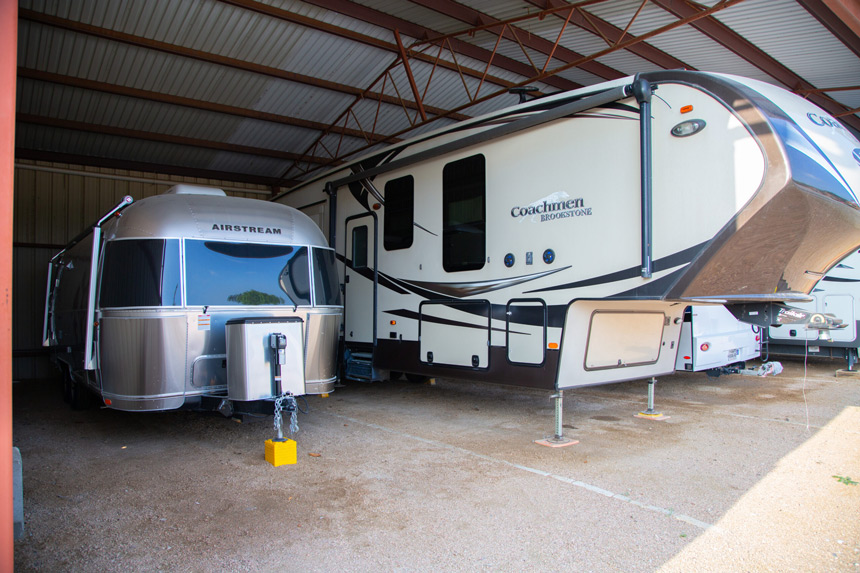
- Travel trailers. The pivot point sits at the hitch, well ahead of the rear, so the trailer tends to follow your steering predictably.
- Fifth wheels. The pivot point sits back over the truck bed, which tightens the turning radius and generally makes them easier to back than a travel trailer of similar length, despite the size.
- Class A motorhomes. No trailer to track, but length and rear visibility are the trade-offs a backup camera mostly closes.
- Class C motorhomes. Shorter on average and easier to judge from the cab, though the cutaway body still leaves blind spots behind the rig.
None of this is a hard cutoff. Backing gets noticeably harder past the 35-foot mark for towables, less about the number and more about how much rig swings behind a pivot point you can’t see.
Which Side Your Hookups Land On

Most RVs place their water, sewer, and electrical hookups on the driver’s side, toward the rear. That’s not just habit: the National Electrical Code requires the power-supply entrance to sit within 15 feet of the rear and left of the vehicle’s longitudinal center, which is why the convention holds across manufacturers. Every Miller Creek site carries a 20/30/50 amp service with water and sewer, matching that convention.
What catches first-timers is that the pedestal position flips between the two site types, even though your rig’s hookups stay put. Back into a back-in site, and your driver’s-side hookups generally land toward the right as you face the site from the road. Drive straight through a pull-through, and that same side lands toward the left as you look down the site in the direction you drove in.
That flip means real consequences: how far your hoses and cords need to reach, and which way your door and awning end up facing your neighbor. If your rig has hookups in a non-standard spot, confirm pedestal position before you book. Position varies by park, and it’s often visible in site photos or on a park map. We publish a photo of each site type and a downloadable park map, though neither will pin down the pedestal on a specific site, and that one is worth a call.
Not All Back-Ins Are Equally Hard
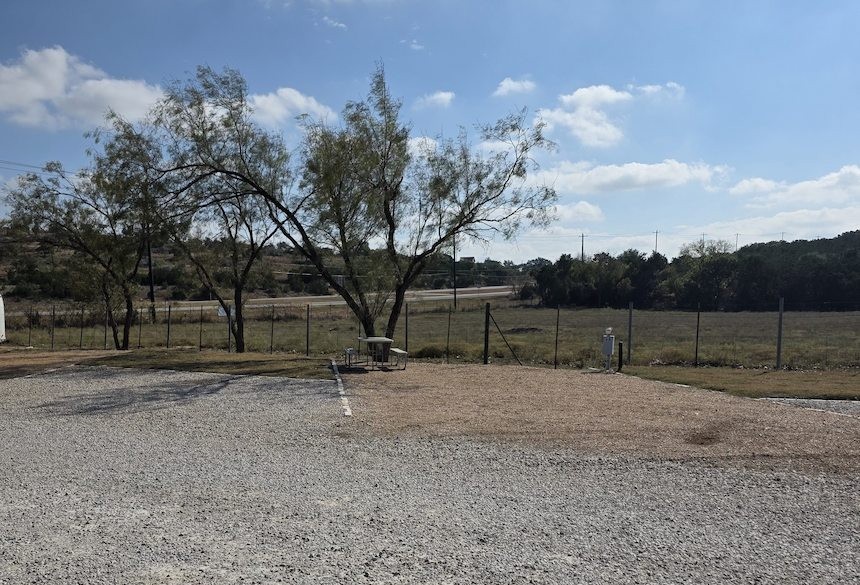
“Back-in” isn’t one level of difficulty. Approach angle is the biggest variable: a slanted back-in lets you swing the rig in on a shallow turn, closer to an angled parking space than a full reversal, while a perpendicular site demands a genuine ninety-degree maneuver from a standing start.
Road width matters just as much as the site; a narrow interior road gives you less room to set up your angle before you commit. Neighboring rigs and fixed obstacles like pedestals and trees shrink your margin further on an otherwise easy site.
The actual technique is its own topic, and this beginner RV camping guide covers it in more depth than a few sentences here could. What’s worth saying plainly: needing a spotter is completely normal, not a sign you booked the wrong site type. Most experienced RVers remember someone walking over to guide them in early on.
Sun, Shade, and Which Way You End Up Facing
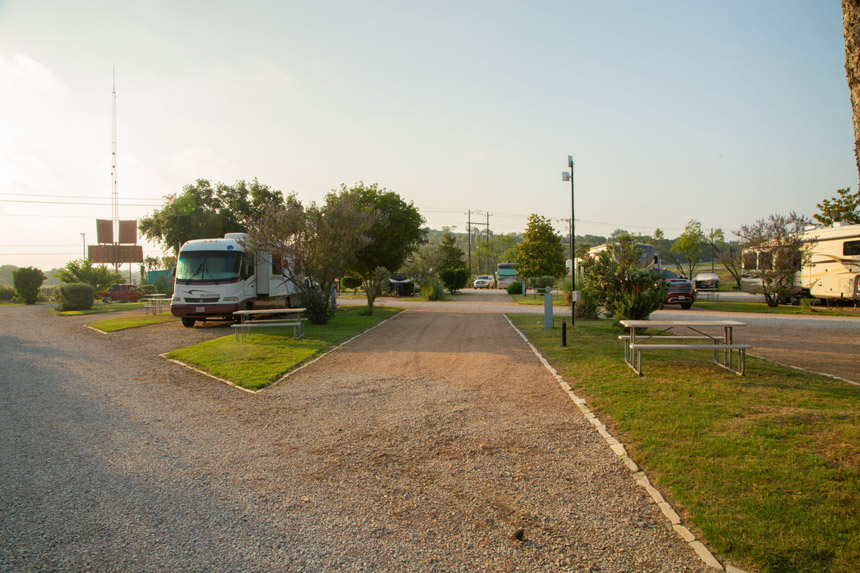
Orientation matters more in Central Texas than across most of the country, where summer afternoon heat is less of a factor. A pull-through’s facing direction is fixed by the drive lane; a back-in gives you a real choice, since the rig can be positioned facing either way.
The standard guidance holds up here: afternoon sun from the south and west is the dominant heat load through the Hill Country’s long, hot stretch of the year. An awning facing east or southeast catches morning shade instead of afternoon glare, and a shorter wall facing west limits direct sun. That shifts with the season; a back-in under established trees beats a perfectly oriented pull-through in open gravel.
How to Size Up a Site Before You Book
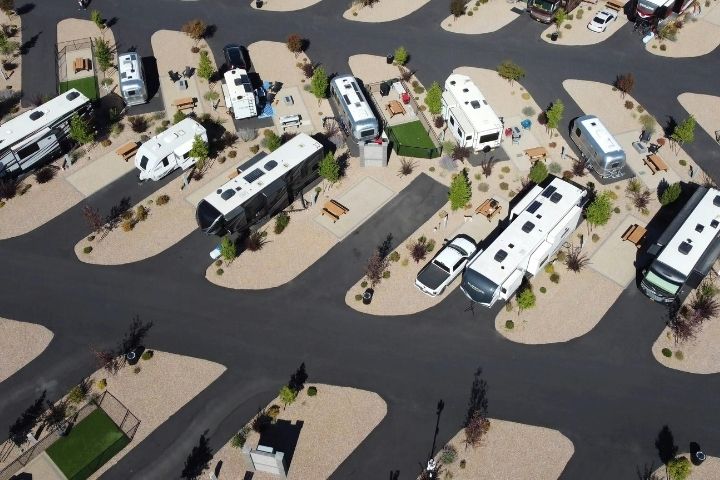
Before you call anyone, there’s a real amount you can check yourself.
Without calling:
- Published site dimensions to confirm your rig and tow vehicle math actually works.
- A park map for layout, road width, and roughly which sites face which direction.
- Satellite imagery to fill in shade and tree cover a map won’t show.
- Site photos, your best source on pedestal position and approach angle. We publish dimensions for every site type and a downloadable park map, and both are worth pulling up before you call anyone.
Worth a call to the office:
- Approach angle on the specific back-in site you’re considering.
- Where your tow vehicle park if it doesn’t fit on-site hitched.
- Whether the site type is selectable at booking.
- Whether photos of that exact site are available.
None of that should be guesswork left for the day you arrive.
Choosing a Site at Miller Creek RV Park
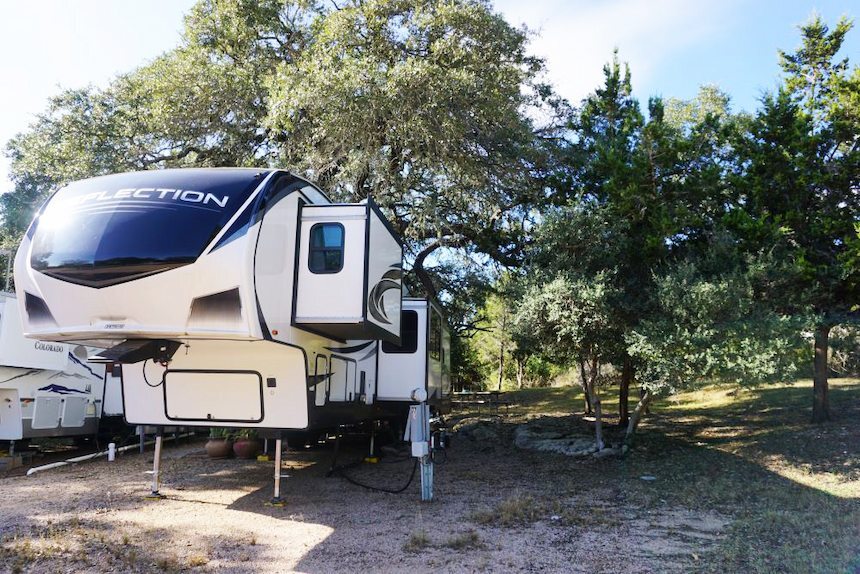
Applying this article’s own framework to Miller Creek rather than pitching it: we run one pull-through type, the Standard Pull-Through, and three back-ins: the Standard Back-In, the Large Yard Back-In, and the Creek Side Back-In. Our RV site types publish the Standard Pull-Through and Standard Back-In at the same approximate 15-foot by 45-foot footprint, so choosing between those two is a convenience decision, not a space or price one, at nightly and weekly rates.
The sites with anything distinctive about them are back-in only. The Large Yard Back-In is the double lot, approximately 22 feet wide by 40 feet long, with room for two cars side by side next to the rig. Note the trade: it’s the widest site type in the park and the only one that isn’t 45 feet long, so run your combined length against 40 feet rather than 45 if you’re considering it. The Creek Side Back-In carries views of Miller Creek, though water level varies by season. Ruling out back-ins by default rules out the most distinctive sites, which makes the pull-through’s real advantage here arrival convenience, not space or price.
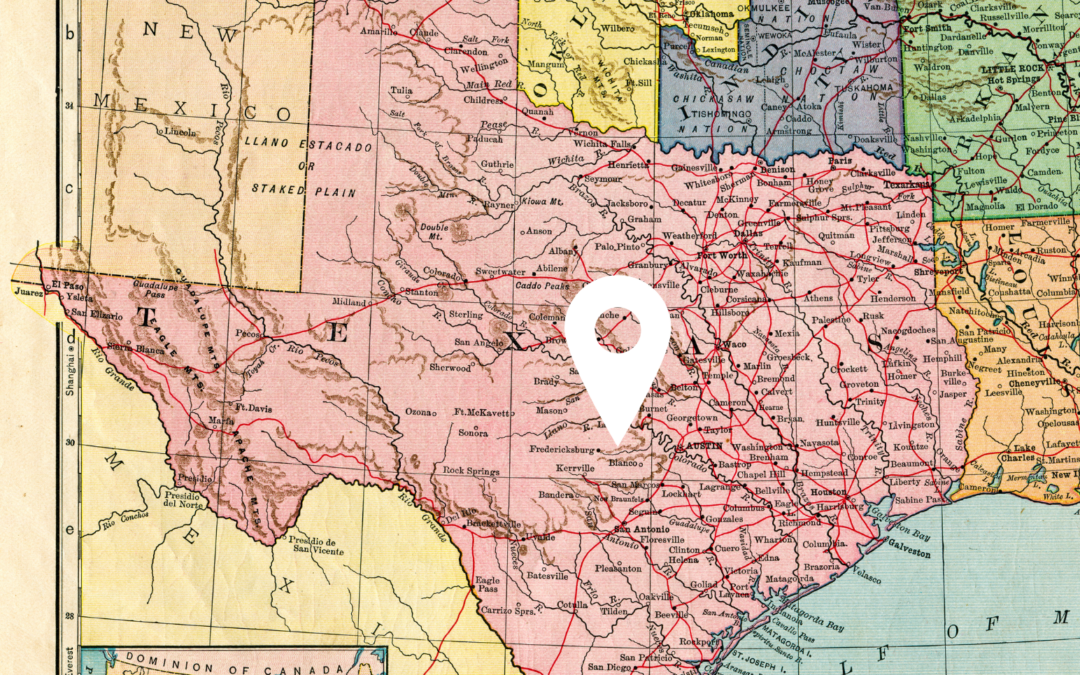
We sit between Johnson City and Blanco, about five miles from Johnson City, with easy access on and off U.S. 281. That matters most on arrival, whichever site type you book.
Quick Answers
Which is easier for a beginner, pull through or back in?
A pull-through, since it only requires forward driving. A back-in is learnable and eases quickly with practice, and asking a neighbor to spot you is normal at almost any park.
Is a pull-through RV site always more expensive?
No. It’s a common pattern, not a rule. Miller Creek prices its Standard Pull-Through and Standard Back-In identically at nightly and weekly rates, though the pull-through costs more at the monthly rate.
Can I leave my truck hitched in a pull-through site?
Only if the combined length of your rig and tow vehicle fits within the site’s published length. Confirm with the park directly if you’re close to the limit.
Which side will my hookups be on?
Generally, the right side of a back-in site and the left side of a pull-through, following the driver’s-side convention most RVs use, though pedestal position varies by park and is worth confirming from site photos or a map.
Are back in sites bigger or smaller than pull-throughs?
It depends on the park. At Miller Creek, the Standard Back-In and Standard Pull-Through are published with the same approximate dimensions.
Do I need a spotter to back into a site?
Not strictly, but accepting help is common and normal, especially on a perpendicular back-in or a tight interior road.
Which type is more common at RV parks?
Back-in sites, since a drive-through lane takes up more land per site than a back-in row does.
The Right Site Is the One That Fits the Trip
The pull-through vs back in RV site call is a function of stay length, rig-and-tow-vehicle length, and how much control over orientation and privacy the stay calls for, not a measure of how good a driver you are. Whether your next site is one of ours or one you pull into after a long day in a town you have never stayed in, the same three questions settle it. Run your own numbers, check what the site photos and map show, and ask the office the questions no listing answers; the choice usually gets obvious fast.
If you’re weighing this decision for a Hill Country stay, Miller Creek RV Park sits between Johnson City and Blanco with full-hookup sites across both site types. Call the office at (830) 868-2655 with your rig’s numbers in hand, or check current availability.