RV retirement living in one long-term park comes down to a monthly site rate, often plus electric, and that rate is only one line of a retirement budget. Rates vary with location, site type and what the park includes, so the clearest way to show the math is with real published numbers. This guide uses one park’s rate sheet as a worked example: Miller Creek RV Park in Johnson City, Texas, where monthly full hookup sites start at $450 plus electric (as published in October 2026).
Parks marketed as retirement RV parks or senior RV parks are usually long-term parks of this kind: you pay a monthly site rate and treat the RV as a small home with a fixed address. If you are looking for a licensed care facility or an owned-lot community instead, the comparison table further down shows how those differ.
What RV Retirement Living Costs Per Month in a Long-Term Park

Monthly rates usually sit well below nightly ones, partly because the park does not have to rebook the site every few days. Here is what that looks like on a real rate sheet, using Miller Creek’s published monthly rates:
All four are full hookup sites, as published on the RV sites page in October 2026. For scale, the same standard back-in is $52 a night, so 30 nights booked nightly would run $1,560; by the month it starts near $15 a night before electric.
The site rate is not the whole monthly bill. At this park, electric is billed on top; the monthly rate assumes two adults, with $60 a month for each additional guest; and a monthly stay takes a $100 deposit and one month’s written notice to end, all set out in the park’s guest guide. A general RV park cost guide covers these extras in more detail. For a retiree, the more useful question is what they do to a fixed monthly income, which the Social Security section below works through.
Electric is the one line nobody can quote in advance. In a Hill Country summer, air conditioning is usually what drives it, so ask any park for the usage history on the site you are considering before you sign.
What to ask before comparing monthly rates
Two parks with the same monthly rate can deliver very different value, because of what comes with the site. Before comparing rates, ask each park:
- Which utilities come with the site, and whether electric is billed separately
- Whether Wi-Fi is included, and whether a faster tier costs extra
- Where laundry is and how it is paid for
- Which shared spaces residents can use, such as a rec hall, fitness room or dog area
- Whether restrooms and common areas are accessible, if mobility matters to you
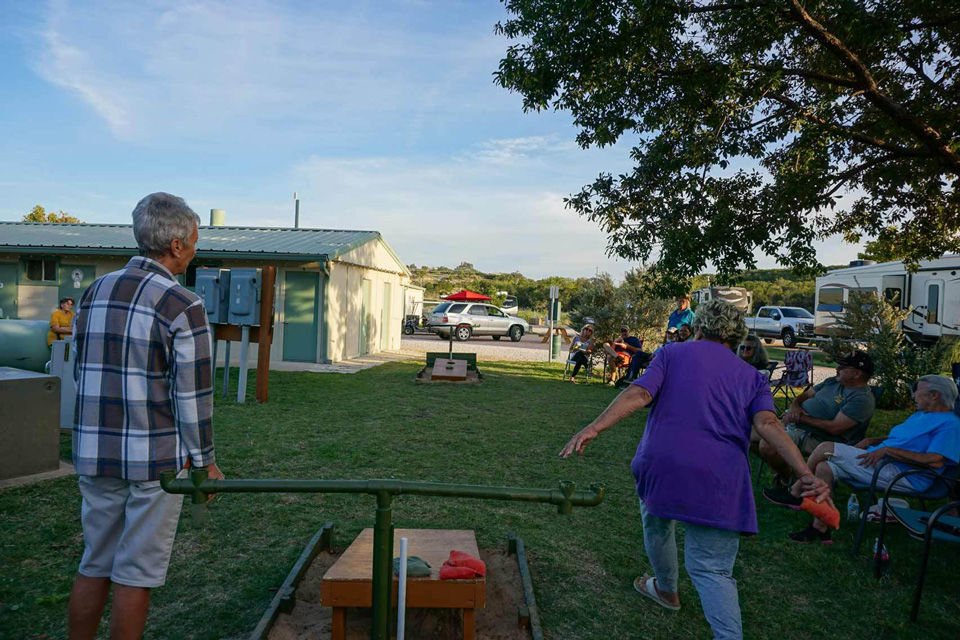
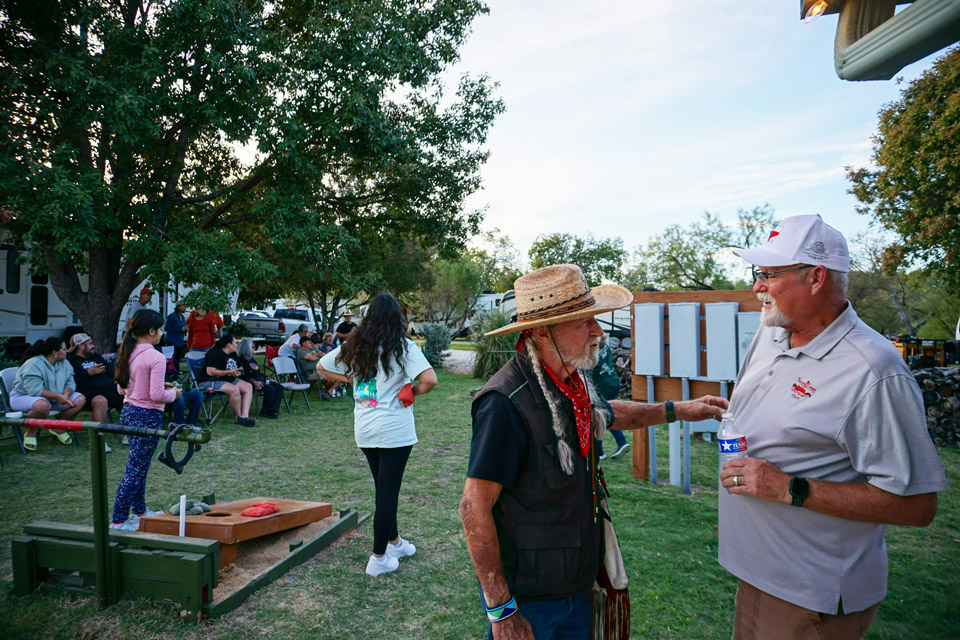
At Miller Creek, for example, every site is full hookup, and residents have access to a rec hall with a full kitchen, a 24-hour fitness room, two laundry rooms, two dog runs, a community restroom with handicap accessibility, and free basic Wi-Fi with upgraded broadband available.
Can you live in an RV on Social Security?
Many people can, at least on the housing line, but the math has to include more than site rent. After the 2.8% cost-of-living increase that took effect with January 2026 payments, the Social Security Administration estimated the average monthly benefit for retired workers at about $2,071. If you are 65 or older and enrolled in Part B, the premium is usually deducted from your Social Security payment (higher-income enrollees pay more), and CMS set the 2026 standard Part B premium at $202.90 a month. That leaves roughly $1,868.
Against that $1,868, the example park’s monthly rates before electric work out like this:
- Standard back-in from $450: about 24% of the remaining benefit
- Pull-through or large yard from $575: about 31%
- Creek side from $625: about a third
Your own benefit may be well above or below the average, so run the same math with your real figure. If two of you draw benefits, use your combined figure minus a Part B premium for each of you, and check how many adults the monthly rate covers; Miller Creek’s, for example, is based on two adults per site.
Timing matters as much as the amount. Social Security is paid on the second, third or fourth Wednesday of the month depending on your birth date (or on the 3rd if you started receiving benefits before May 1997 or receive both Social Security and SSI), according to the SSA payment schedule. Monthly park rent may be due earlier. Miller Creek, for example, charges monthly rent on the 1st, adds a $5 daily late fee once payment is more than four days late, and reviews renewal after a second late payment. Keep a month’s rent in reserve, or ask before you sign whether a different payment arrangement is possible.
Costs that do not go away when you stay put
- RV insurance, which some insurers price differently when the RV is your full-time residence
- Maintenance and repairs on the RV, including roof, seals, tires and appliances
- A vehicle for errands, plus its insurance and fuel
- Medicare supplement, Advantage or drug plan premiums beyond Part B
- Phone and, if the park’s Wi-Fi is not enough, an internet upgrade or hotspot
- Propane in cooler months
Build your budget from all of these lines, not site rent alone, and leave a cushion for repairs. Our RV retirement planning checklist goes deeper on budgeting, Medicare coverage and choosing a domicile state.
Retirement RV Parks, RV Retirement Communities and Assisted Living: How They Differ
People search for “senior RV parks,” “RV retirement communities,” and “assisted living RV parks” as if they were the same thing. They are not, and the difference decides what you pay, what you own, and what happens if your health changes.
Miller Creek, the park used in the cost examples above, falls in the first column: its guest guide states that all ages are welcome, and it is an RV park, not a care provider.
What “assisted living RV park” usually means
In Texas, assisted living is a licensed category. The Texas Health and Human Services Commission licenses assisted living facilities, which provide individualized health and personal care assistance. An RV park without that license is not an assisted living facility, whatever its marketing says.
One real hybrid is Escapees CARE in Livingston, Texas, a program built so retired RVers in the Escapees community can age in place in their own RVs with services such as meals and transportation. It is a specific program for a specific group, not a type of park you will find in every region. If you or a partner already need daily help, start from licensed care options and work back, rather than starting from an RV park and hoping it fits.
If you want an age-restricted community
Age-restricted RV communities suit retirees who want neighbors at the same life stage. Our list of retirement RV parks in Texas popular with RVers 55 and older is a place to start; check each park’s age rule directly, since not every park on it is age-restricted.
Staying in One Park vs Traveling Full Time
Many common warnings about RV retirement, from fuel costs to the scramble for campground reservations, are really warnings about traveling. Staying in one park removes many of them, but not all.
Neither version is cheaper by default. A traveler who stays at low-cost campgrounds can spend less on sites than a monthly resident. The difference is predictability: a monthly resident knows the housing line on next month’s budget before the month starts, which matters a great deal when long-term RV living runs on a fixed retirement income. Many retirees end up doing both, with a home-base site for most of the year and shorter trips from it.
What staying in one park does not fix
- The RV keeps aging. Many long-term parks limit RV age; Miller Creek generally does not accept RVs older than 10 years without a management exception. An RV bought at the start of retirement may limit which parks will accept it later, if you ever want to move.
- The RV has to suit your body. Entry steps, a high bed and a small bathroom are easy at 65 and can become a reason to leave later on, so check them before you buy.
- Health can change faster than a lease. If daily help becomes necessary, an RV park is not a care provider, which is why the comparison above matters.
The Park Rules That Decide Whether You and Your RV Get In

Long-term parks often screen RVs and residents more closely than overnight campgrounds, because you will be there for months. Ask any park for its rules in writing. The ones that matter most to retirees usually cover the RV itself, repairs, vehicles, pets and payment, and Miller Creek’s published rules are one example:
- RV age: RVs older than 10 years are generally not accepted but may receive an exception from management. Age limits like this are common at long-term parks, but the cutoff and how strictly it is applied vary. If your RV is older, ask before you book whether an exception is possible.
- Road-ready: the RV must be licensed, insured, currently registered and road ready, with leak-free water connections.
- Repairs: vehicle repair is not allowed in the park, except by a mobile RV repair service. If you planned to do your own maintenance in retirement, that matters.
- Vehicles: two vehicles per site, both registered with the office. Additional vehicles need permission.
- Pets: a maximum of two dogs per site, with current vaccination records, leashes no longer than 6 feet outside designated areas, and no aggressive dogs.
- Payment record: after a second late payment, renewal of a monthly agreement is subject to review.
Can you live in an RV park permanently? Inside a park, what keeps you there long term is a renewable agreement, an RV that meets the park’s standards and a clean payment record. Outside a park, local zoning and deed restrictions decide where full-time RV living is allowed, which our guide to Texas RV living laws covers in detail.
How to Test RV Retirement Living Before You Commit
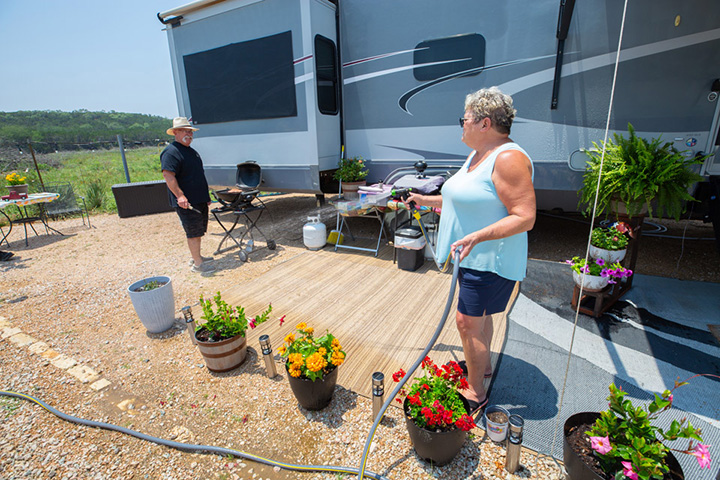
Do not sell the house and sign a year-long agreement in the same month. Test the stationary version of RV retirement first.
- Start with a short stay. A few nights is enough to see the site, the neighbors and the noise level before you commit to anything longer.
- Book one month. A single month shows you a real electric bill, how the RV handles daily living, and whether the routine suits you. Use it to map real drive times to the nearest emergency room, your primary care doctor and any specialist you see, and if you are on a Medicare Advantage plan, confirm it covers the county the park is in.
- Try a full season, ideally the one you expect to find hardest. In Texas that usually means summer heat, when electric bills and time spent indoors tend to peak.
For an honest look at the day-to-day once you are settled, from mail and Wi-Fi to weather and site upkeep, read what RV park living is really like.
Quick Answers
Is a retirement RV park the same as an age-restricted RV community?
Not always. “Retirement RV park” is a marketing term. Some are age-restricted; many are all-ages parks. Ask whether an age rule applies and how.
Do RV parks offer assisted living?
Generally no. Assisted living is a separately licensed type of facility in Texas, and an RV park is not one. One specialized program, Escapees CARE in Livingston, Texas, offers services such as meals and transportation to retired RVers in the Escapees community living in their own RVs.
Do RV parks accept RVs older than 10 years?
Policies vary, and some long-term parks set an age limit on RVs. Ask before you book, and ask whether exceptions are made for RVs in good condition.
Retiring at Miller Creek RV Park
If the stay-in-one-place version of RV retirement fits you, Miller Creek RV Park is a Hill Country base about 5 miles from Johnson City, within reach of Austin without living in the city. It is an all-ages park with full hookup sites, a rec hall, a 24-hour gym and monthly rates built for long stays.
Monthly sites start at $450 for a standard back-in, $575 for a pull-through or large yard site, and $625 for a creek side site, plus electric, as published in October 2026. For a trial run, the Get 1 Night Free offer gives you one more night free when you pay for at least one at the regular rate, on stays of up to six nights; for longer stays, the Winter Texan Snowbird Special rewards longer winter stays, and the Long-Term Special adds incremental monthly savings worth up to $1,000 over a year. Terms are on the promotions page.
Monthly stays are booked by phone: call the office at 830-868-2655, Monday to Friday 9am to 5pm and Saturday 9am to 1pm, with questions about RV age, longer stays or current promotions. For a short trial stay, check nightly availability.